

This post was written by Melissa Ashman and Kathryn Johnson.
Introduction
The members of the GO-GN Canada regional hub have had ambitious deliverable goals. We participated in a land-based learning opportunity at the Cultural Use Area in Jasper National Park in September 2025, bringing together educators from across the country to learn with and from Nêhiyaw Darrion Letendre and Niitsitapi Knowledge Keeper Lance Scout. We are preparing an open education resource on Indigenous knowledges and open education that will be published in early 2026. We have created a digital space on Discord to build and foster community.
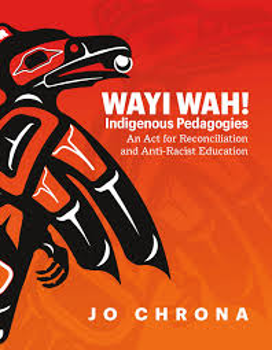
As well, over the course of four months, members of the project team have been reading and discussing Wayi Wah! Indigenous Pedagogies: An Act for Reconciliation and Anti-Racist Education by Jo Chrona as part of a book study. Co-facilitated by Melissa Ashman and Kathryn Johnson, the book study has been an opportunity to build community within the regional hub while simultaneously facilitating individual and group reflection on Indigenous pedagogies and its possible intersections with open education. The book study also expanded our membership by engaging scholars who were not initially part of the GO-GN Canada regional hub. By employing synchronous meetings in Teams and asynchronous communications via Discord, we’ve maximized opportunities for participation.
“One important aspect of Indigenous knowledge systems is that they respond to, and honour, context. Who I am, where I write from, and the land I am now on informs what I share with you. Knowledge and understanding are entrenched in relationship and connected to people and place.”
– Jo Chrona in Wayi Wah! Indigenous Pedagogies: An Act for Reconciliation and Anti-Racist Education
The Process
In order to move forward in a good way together, we began our book study by co-developing shared expectations and norms. These included the following: intentionally not recording the meetings in order to respect knowledge sovereignty and encourage contributions; listening with an open mind and an open heart; speaking only from our own experience; and creating space for trust, respect, courage, humility, safety, and simplicity.
It was important to not only create these guidelines and put them in writing, but to do so collaboratively and in community, as the conversations potentially could be uncomfortable or difficult at times.
We then met every couple of weeks to discuss portions of the book. Each session began with a member sharing their land acknowledgement, which created space for personalized and individual meaning-making about where and how we live and pursue our educational activities. These land acknowledgements reflected the group’s geographic and cultural diversity and resulted in new opportunities for additional learning beyond our discussion of Wayi Wah! Sharing these personalized land acknowledgements also facilitated members getting to know each other, thus strengthening our trust and connections across the regional hub.
As we dove into the chapters, book study participants asked questions of each other, shared their reflections, and wondered aloud together. We shared moments of sorrow and hope. Our discussion topics ranged from the impact of European colonization to individual acts of reconciliation. Across that broad spectrum we deliberated how Indigenous education is different from multicultural education, how education systems can change to be more inclusive, the various manifestations of intentional and unintentional bias and discrimination, and how we as individuals can be conscious of and dedicated to acts of reconciliation within our classrooms, institutions, and communities. Via deep discussions supported by humility and safety, we are committed to moving forward to create a more open, equitable, and open world.
Overall, the meetings have been thought-provoking and enriching, allowing us to deepen our understanding of Indigenous pedagogies generally and in relation to open education.
Participant Reflections
Some of the participants in the book study have provided short reflections on their experience and learning:
Wayi Wah! Indigenous Pedagogies was my introduction to an academic book study and it was an ideal choice. The text is well-suited for collaborative inquiry, with reflective questions that led to meaningful discussions within our group – particularly around systemic racism in educational systems and how it manifests, consciously or unconsciously. Given the importance and timeliness of Indigenous pedagogies, having a study group to support my understanding has been essential for deeper learning.
Emily Grady, MEd candidate
This book study prompted me to consider how a land acknowledgement could be personally meaningful and how I can better support the Indigenous learners in my institution while advocating for increased Indigenous knowledge to be incorporated into our university’s new strategic planning initiative.
Kathryn Johnson, EdD
The book is a highly informative exploration of Indigenous perspectives of knowing and education. Of particular value and central to the storytelling and perspectives of the author Jo Chrona in their work Wayi Wah! Indigenous Pedagogies are the First Peoples Principles of Learning. These are articulated as follows:
- Learning ultimately supports the well-being of the self, the family, the community, the land, the spirits, and the ancestors.
- Learning is holistic, reflexive, reflective, experiential, and relational (focused on connectedness, on reciprocal relationships, and a sense of place).
- Learning involves recognizing the consequences of one‘s actions.
- Learning involves generational roles and responsibilities.
- Learning recognizes the role of Indigenous knowledge.
- Learning is embedded in memory, history, and story.
- Learning involves patience and time.
- Learning requires exploration of one‘s identity.
- Learning involves recognizing that some knowledge is sacred and only shared with permission and/or in certain situations
(Wayi, Wah!, 2022, p. 118).
These are many ways in which we believe we might be engaging in the practice of teaching and research in our work, but just reading the list might bring up some opportunities for improvement, especially, and centrally in magnifying Indigenous knowledge (noting that some knowledge is sacred and not to be shared). Replace the word “learning” with “research” for a moment and consider your practices again in the context of reconciliation with Canadian and global Indigenous peoples.
Jo Chrona’s work is an exploration of these principles with multiple opportunities for reflection for you as a reader and educator about your own practice, and informative stories about their journey learning and making mistakes as part of growth into reconciliation with First Peoples. An essential read in my experience and I’m grateful for the opportunity of this GO-GN Canada book club to learn about others’ experiences reading this work.
Jenni Hayman, GO-GN Canada member
The line that stayed with me most was Jo Chrona’s reminder that “change happens at the speed of trust.” The tone and voice of the book also invited me to trust, showing that building a relationship with any community and learning from them happens through openness and humility, and through honouring their stories, their lands, and their beliefs. In a world shaped by constant change, trust matters because it is what makes meaningful change possible.
Gelareh Keshavarz MEd, EdD Student
Reading this book is much like being guided through a thoughtful, reflective journey. Jo Chrona shares her experiences and knowledge in such an honest and human way, which cultivates the reader’s openness to question their own actions and thinking. Each chapter pulled me inward with reflective questions and then pushed me to look again through the sharing of other educators’ reflections, which continually reshaped my thinking. What a necessary read for all of us.
Joanne Kehoe, MEd, PhD Student
Next Steps
Moving forward, the GO-GN Canada regional hub plans to continue hosting the book study and to expand participation. If you are interested in joining, you are warmly welcomed to email melissa.ashman@kpu.ca.
