

This post is by GO-GN scholarship awardee Dr. Jess O’Reilly (Cambrian College).
A GO-GN scholarship provided me with the opportunity to participate in the OTESSA 2025 conference, held in early June in Toronto, Ontario, with co-located conference sites occurring in Victoria, Sante Fe, and fully online. The Toronto site offered a quieter, connected experience, and I really appreciated the opportunity to engage in a space that encouraged deep conversations, renewed connections, and the flexibility to move off-script. Here are a few moments that stood out for me:
People! In Person!
The conference Co-Chairs Dr. Michael Paskevicius and Ann Ludbrook were organized, gracious, and so thoughtful. It was wonderful to finally shake Michael’s hand, as he’d been instrumental in assisting me with my doctoral dissertation study last year, but we’d worked exclusively online as he’s located in western Canada and I’m in Ontario.
It was similarly wonderful to meet the Co-Directors of GO-GN “in real life”. Dr. Beck Pitt and Dr. Rob Farrow are scholars who I admire immensely, and it was an added bonus to have several opportunities to chat with them and others about important topics such as the future of Open Education in the face of AI, traditional knowledge and the Commons, whether or not pickerel is a type of pike, and the merits of restaurants that rotate slowly, among other things!
I also reconnected with Helen DeWaard, who I first met through eCampus Ontario’s Open Education Fellowship program years ago, back when I was just starting out in open education. Now, we’ve both completed our degrees and delighted in greeting each other with a “Hi Doctor!”. It truly felt like a full-circle moment.
The Keynotes
Each keynote brought something meaningful and timely to the conversation. Dr. James Slotta invited us to rethink learning as a collaborative, inquiry-driven process. He spoke about the power of classrooms as communities where students create knowledge together, and spoke fondly of the inspiring, and at times chaotic, inquiries that he’s witnessed through the Critical Action Learning framework.
Dr. Anatoliy Gruzd exposed the scale and speed at which generative AI is fueling misinformation online and offered practical ways we can respond through education, detection tools, and policy. I appreciated the broader scope of his talk, which focused not just on AI’s impact in educational spaces but on society broadly. His direct calls for increased epistemic resilience grounded me in real actions that I can bring into my classroom immediately, a refreshing antidote to the thoughtless techno-solutionism that seems to plague contemporary higher education.
Dr. Jennifer Wemigwans closed with a powerful reminder of the responsibilities that come with sharing Indigenous knowledge online. Her concept of “digital bundles” fascinated me, and I greatly admire the respect for protocol, relationship, and reciprocity that her work embodies. What I am left with is the deep, deep care that she feeds into her work. She is a role model and someone I will continue to follow.
Final Thoughts
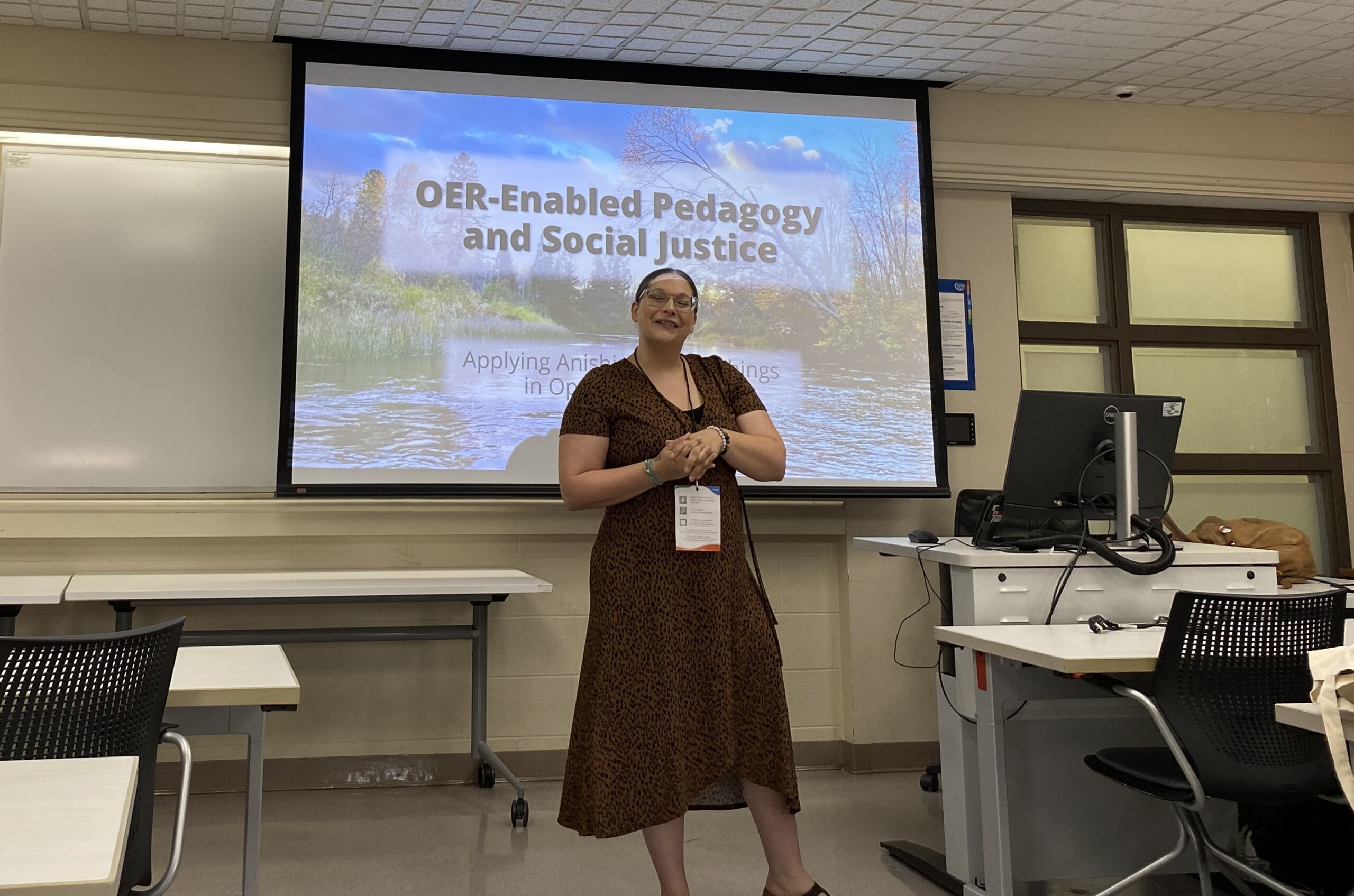
My own sessions went well, and I loved many of the sessions that I participated in throughout the conference. I’m always inspired by those involved in open education, their commitment to the Commons and to each other. The conference closed with a circle talk that made space for us to speak openly about important topics and offer some parting thoughts. It wasn’t formal or flashy, but it was real, and real is something we’re all needing more of right now, I think.
As I travelled home from OTESSA I found myself immensely grateful for the opportunity to reconnect. Grateful for the leaders who drive this work, and for all the people who, in their own unique ways, use their gifts to make the world a better place. It is inspiring to be in your presence, to learn more about your work, and to carry your wise words with me as I continue down my own path in open education.
